Pay to Access | Uganda’s New 31 million Barrel Discovery, Regional Energy Shifts, and the Strategic Position of the DRC in the Albertine–Tanga Corridor
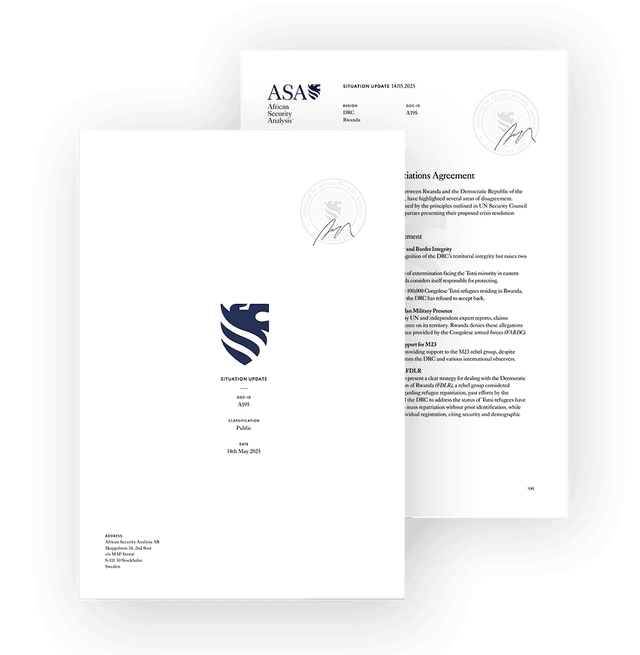
African Security Analysis (ASA) Report
Uganda’s confirmation of a 31 million-barrel discovery at Kingfisher North –together with up to 600 million barrels of new prospects identified by UNOC –marks a major expansion of the Albertine Basin. With Tilenga and Kingfisher advancing and the EACOP pipeline nearing full construction, Kampala is consolidating its role as East Africa’s dominant upstream actor.
Meanwhile, the DRC remains without a coherent Albertine Basin strategy, despite holding nearly half of the region’s geological potential. This vacuum intersects with security dynamics: UPDF’s sustained deployment in eastern DRC increasingly aligns counter-ADF/ISCAP operations with Uganda’s long-term energy interests.
This report contains:
- Discovery & Production Outlook – Key data on Uganda’s new reserves, operator roles, and expected impacts on national output.
- Regional Energy Architecture – How EACOP, Tanzania’s export position, and corridor competition are reshaping East Africa’s energy map.
- The DRC’s Strategic Gap – Missing legislation, exploration policies, and cross-border coordination affecting Blocks I & II.
- Energy–Security Overlap – ADF/ISCAP threats, basin militarization, and UPDF’s operational posture in DRC territory.
- Geopolitical Competition – China, France, the EU, and U.S. stakes in emerging infrastructure corridors.
- Strategic Recommendations – Priorities for basin governance, stabilization, and energy-security alignment.
Essential reading for policymakers, investors, risk analysts, and institutions navigating the evolving energy–security landscape of East and Central Africa.

This purchase will be made in cooperation with PayPal. Use PayPal account or credit card unlock.


Discover More
Sovereignty Against Spillover: The AU Summit's Good-Neighbourliness Bid and the DRC–Rwanda Test of a Contradictory Doctrine
The month's only summit-level session convenes on 23 September in New York, on the margins of the 81st UN General Assembly, under the theme 'Good Neighbourliness and Regional Responses to Security and Terrorism Challenges in Africa.'
Climate as a Threat Multiplier in the Sahel and Lake Chad: The AU's Decade of Recognition Meets Its Capability Deficit
On 18 September the PSC holds the only open session of the month, on the nexus between climate change, peace and security — a standing agenda item since the 585th session in March 2016 and now the subject of at least two sessions a year.
REQUEST FOR INTEREST
How can we help you de-risk Africa?
Please enter your contact information and your requirements and needs for us to come back to you with a relevant proposal.